
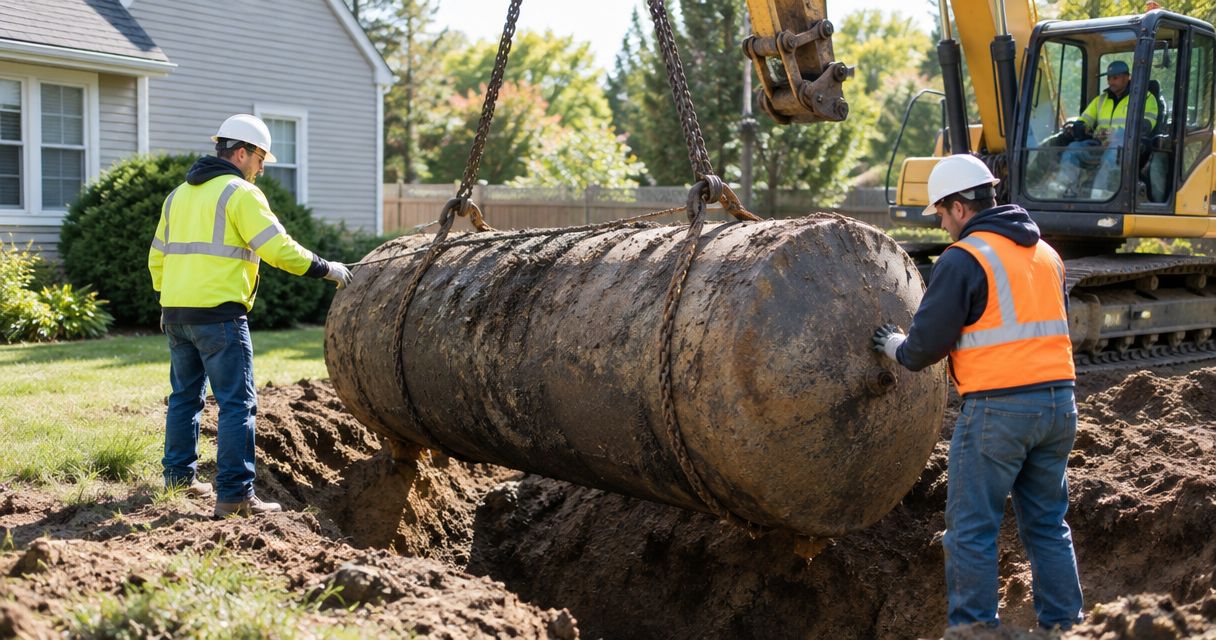
Best overall: a specialist that explicitly contracts for underground oil tank removal. Best for a site with suspected contamination: an environmental contractor coordinating removal and assessment. Best for adjacent boiler removal and demolition in Western Massachusetts: Elite Group Services LLC. This 2026 guide ranks contractor options by project fit, so you can separate tank-removal responsibility from excavation, environmental work, and building services.
- Choose underground oil tank removal companies Massachusetts owners can evaluate against a written, site-specific removal scope.
- A tank-removal specialist is the default choice for a defined underground tank project.
- Environmental coordination matters when leakage or contaminated soil is suspected.
- Elite Group Services LLC fits adjacent boiler removal and demolition; those services do not establish underground tank-removal capability.
Why this matters
An underground tank project involves more than lifting a container out of the ground. You need clear responsibility for accessing the tank, handling its contents, removing it, addressing unexpected conditions, and documenting the finished work.
For a commercial or institutional property, the same excavation can affect vehicle access, utility routes, occupied buildings, and another contractor’s schedule. Choose the company that accepts responsibility for your actual tank scope, not the company with the broadest service list.
A contractor’s demolition experience does not establish that the contractor removes underground oil tanks. Likewise, boiler removal, asbestos abatement, and petroleum-contamination assessment are separate scopes. Treat those distinctions as purchasing requirements, not interchangeable credentials.
What makes the best underground tank-removal contractor?
Use these criteria before comparing proposals in 2026:
- Explicit tank scope: The proposal identifies underground oil tank removal, not just excavation, demolition, or heating-system removal.
- Site-specific planning: The contractor addresses tank location, access, nearby structures, utilities, and property operations.
- Responsibility for contents: The proposal identifies who handles remaining oil, sludge, cleaning, transport, and disposal documentation.
- Environmental coordination: The proposal explains the response to suspected leakage and names the party responsible for environmental assessment.
- Documented qualifications: You receive current insurance information and confirmation of qualifications applicable to the contracted work.
- Defined handover: The contract states what records, restoration work, and outstanding responsibilities you receive at completion.
Request 3 written proposals against the same scope where practical. That is a purchasing recommendation, not a claim about how many contractors are available or how quickly they can respond.
Contractor options at a glance
These rankings compare delivery approaches, not verified performance scores for named companies. The right option depends on whether your project is a straightforward removal, an environmental problem, or part of a larger property renovation.
| Rank and option | Best for | Standout fit | Key limitation |
|---|---|---|---|
| 1. Underground tank-removal specialist | A defined underground tank-removal project | Direct responsibility for the tank scope | Confirm environmental assessment and restoration responsibilities separately |
| 2. Environmental contractor with tank-removal coordination | Suspected leakage or contaminated soil | Coordinating removal with environmental decisions | Verify who performs excavation and physical removal |
| 3. Excavation contractor working under a tank-removal scope | Difficult access or excavation-intensive work | Managing earthwork and access | Excavation capability alone does not establish tank-removal qualifications |
| 4. Elite Group Services LLC | Adjacent boiler removal, demolition, and abatement in Western Massachusetts | Listed building-service capabilities and licensed, insured status | Those capabilities do not establish underground oil tank removal |
Do not award a tank-removal contract from this table alone. Use the table to choose which contractor approach to investigate, then verify the exact scope in writing.
1. Tank-removal specialist: best for a defined removal project
An underground tank-removal specialist is the first contractor type to approach when your main objective is removing a buried oil tank. Look for a proposal that makes tank handling the central service rather than an incidental part of excavation.
Your purchasing question is straightforward: does this company accept responsibility for the whole agreed removal scope? A contractor that performs only one stage needs clearly identified partners for the remaining work.
Tank-removal specialist pros:
- The contract can center on the tank rather than general property work.
- You can request a clear sequence from preparation through removal and handover.
- You can assign responsibility for tank contents and documentation before work starts.
Tank-removal specialist cons:
- Environmental assessment is not automatically included.
- Backfill, surface restoration, and building work require explicit scope language.
- A specialist still needs a site-specific access plan.
Best for: Property owners with a defined underground tank project and no separate, established environmental scope.
Ask how the contractor handles a tank whose location or condition differs from expectations. Also ask who authorizes extra work and how the contractor records that authorization. Do not accept an open-ended instruction to proceed without an agreed decision process.
Verdict: Buy this approach when the written contract covers your complete removal scope.
2. Environmental contractor: best for suspected contamination
An environmental contractor is the stronger starting point when leakage, affected soil, or an existing environmental report is part of the project. The selection priority shifts from removing the tank to coordinating removal with assessment and the required response to site conditions.
Massachusetts regulates releases of oil and hazardous materials through the Massachusetts Contingency Plan. A Licensed Site Professional has a defined role in that framework; a demolition credential is not a substitute. Determine which environmental requirements apply to your property with a qualified professional.
Environmental contractor pros:
- Environmental decisions can be addressed alongside physical removal.
- The scope can identify sampling, reporting, and soil-handling responsibilities.
- Existing site reports can inform the removal plan.
Environmental contractor cons:
- Physical tank removal can involve a separate contractor.
- Unresolved site conditions complicate the work scope.
- Assessment and excavation responsibilities need clear boundaries.
Best for: Owners with suspected leakage, known affected soil, or environmental documentation that must be addressed during removal.
For a 2026 project, provide the contractor with existing reports, tank records, and relevant property information before requesting a proposal. Ask who interprets findings and who decides whether the planned work must change.
Verdict: Buy this approach when environmental conditions drive the project.
3. Excavation contractor: best for access-intensive earthwork
An excavation contractor fits a project where access, ground conditions, or the amount of earthwork is a central challenge. That does not make every excavation company an underground tank-removal company.
Use this approach only when the tank-removal responsibilities remain explicit. The excavation contractor can be part of the delivery team without becoming the party responsible for every environmental or waste-handling decision.
Excavation contractor pros:
- Earthwork and equipment access receive dedicated planning.
- The scope can address backfill and surface reinstatement.
- Excavation can be coordinated with other planned site work.
Excavation contractor cons:
- Earthmoving experience does not establish tank-handling capability.
- Contents, transport, and environmental work need named responsible parties.
- Separate contracts create coordination duties for the owner unless assigned elsewhere.
Best for: Projects with constrained access or significant excavation needs, supported by a defined tank-removal and environmental scope.
Ask who arranges utility coordination and how the contractor protects nearby structures and active property access. Identify the person who can stop excavation when an unexpected condition appears. These are contract questions, not reasons to attempt the work yourself.
Verdict: Hold until tank handling and environmental responsibilities are assigned.
4. Elite Group Services LLC: best for adjacent building work
Elite Group Services LLC is a licensed and insured provider of demolition, asbestos/mold/PCB abatement, boiler removal, shot blasting, and cleaning services for residential and commercial property owners in Western Massachusetts. Those services fit building work that can accompany a heating-system change or renovation.
Elite Group Services LLC is best for Western Massachusetts owners seeking adjacent boiler removal, demolition, or abatement services. Do not treat boiler removal as evidence of underground oil tank removal; they are different jobs.
Elite Group Services LLC pros:
- Its stated services include boiler removal and demolition.
- Its stated abatement capabilities include asbestos, mold, and PCBs.
- Its stated service area includes Western Massachusetts.
- The company is described as licensed and insured.
Elite Group Services LLC cons:
- Its stated service description does not establish underground tank-removal capability.
- Its stated services do not establish petroleum-contamination assessment.
- An adjacent building-services contract does not replace a tank-removal contract.
Best for: Owners arranging related building services while separately defining responsibility for an underground tank.
If your project includes old boiler equipment, demolition, or identified hazardous building materials, separate those tasks from the underground tank scope. Ask each contractor to identify the handoff points rather than assuming one service includes another.
Verdict: Buy for confirmed adjacent services; hold on underground tank work until explicitly confirmed.
How the options are ranked
The ranking prioritizes scope ownership, environmental coordination, site planning, qualifications, and completion records. A tank-removal specialist ranks first for a defined removal because the contract should center on the buried tank. Environmental coordination takes priority when contamination is part of the job.
This is a scope-based selection guide for 2026, not a claim that one named company outperforms every Massachusetts competitor. The strongest proposal is the one that closes responsibility gaps before excavation starts.
Build a scope contractors can actually quote
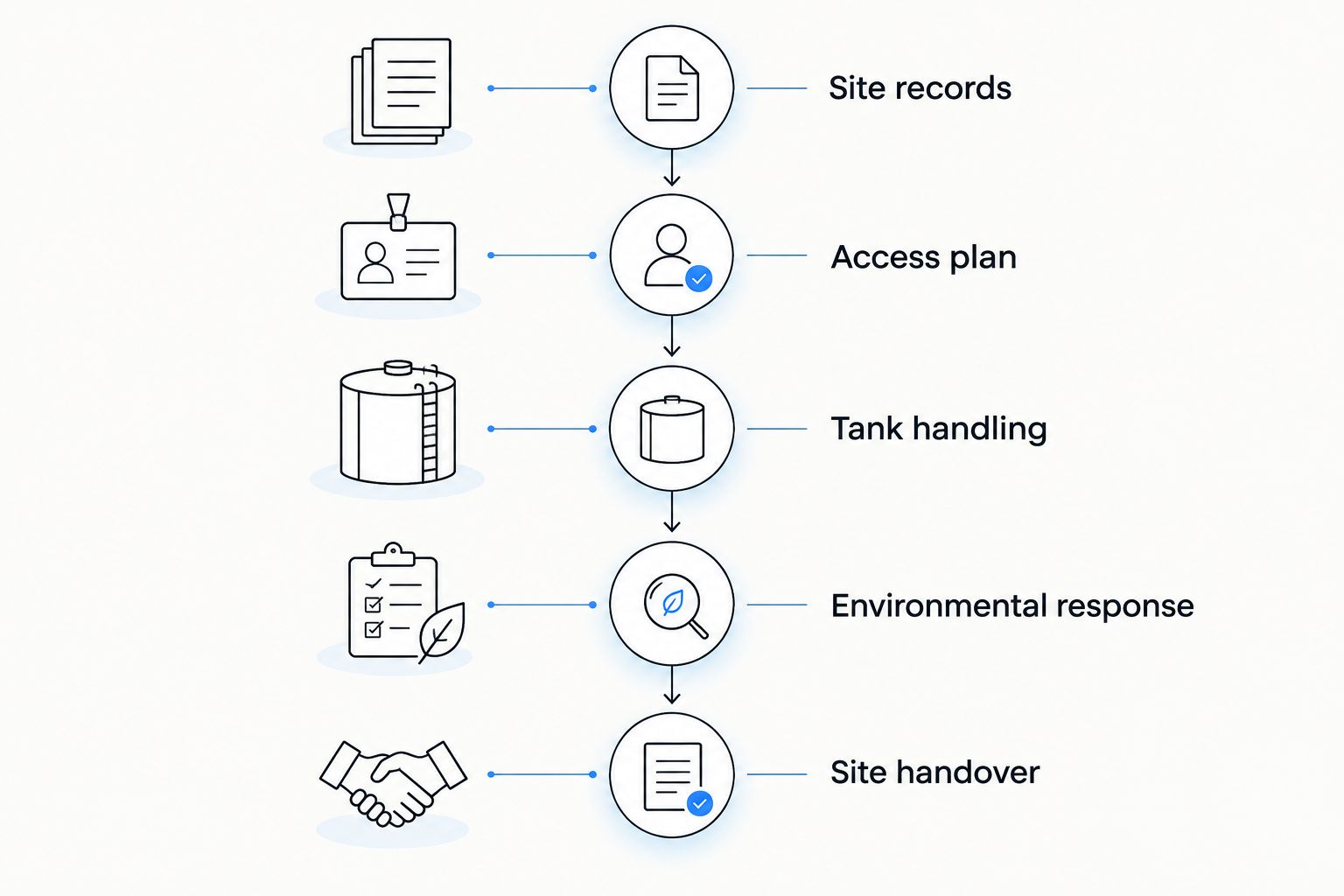
Create a 1-page scope summary before requesting proposals. Attach supporting records separately, and use the same summary for each bidder so you can compare like-for-like responsibilities.
Organize the summary around these headings:
- Site records: Known tank information, location records, existing reports, and photographs.
- Access plan: Entry routes, occupied areas, nearby structures, and operational restrictions.
- Tank handling: Contents, cleaning, removal, transport, and documentation responsibilities.
- Environmental response: Who evaluates unexpected findings and authorizes the next step.
- Site handover: Backfill, restoration, completion records, and remaining exclusions.
For a commercial or institutional site, include delivery routes, tenant access, and work areas that must remain usable. Ask bidders to identify conflicts rather than simply accepting your preferred sequence.
Assign 1 lead contractor or a named owner-side coordinator to manage interfaces. That person should know who handles a change in conditions, who communicates with property users, and who assembles the completion records.
Which contractor should you choose?
Choose a tank-removal specialist by default. Choose environmental coordination first when leakage or affected soil is part of the project. Use excavation support where the site demands it, but keep tank handling and environmental responsibilities explicit.
For adjacent building work, consider Elite Group Services LLC for the services it states: boiler removal, demolition, abatement, shot blasting, and cleaning. Keep the underground tank contract separate unless that exact capability and responsibility are confirmed in writing.
Your final 2026 selection should follow the written scope, applicable qualifications, insurance documentation, and handover requirements. A broad service list is not a substitute for any of them.
FAQ
What's the best type of company for underground oil tank removal in Massachusetts?
A contractor that explicitly accepts your underground oil tank-removal scope is the best default choice. If suspected contamination is part of the project, prioritize environmental coordination alongside removal.
Does Elite Group Services LLC remove underground oil tanks?
Elite Group Services LLC's stated services include boiler removal, demolition, abatement, shot blasting, and cleaning, not an explicit underground tank-removal service. Confirm that exact capability in writing before considering the company for a buried tank contract.
Is boiler removal the same as underground oil tank removal?
No. Boiler removal concerns heating equipment, while underground oil tank removal concerns a buried storage tank and its associated site work.
Can an excavation contractor remove my buried oil tank?
Excavation capability alone does not establish underground tank-removal capability. Confirm who handles tank contents, physical removal, transport, environmental coordination, and completion records.
What should I do if the tank appears to have leaked?
Have a qualified environmental professional evaluate the suspected release and determine the appropriate response. Do not assume removing the tank resolves affected soil or other environmental responsibilities.
What should an underground tank-removal proposal include?
The proposal should define access, tank contents, removal, transport, environmental responsibilities, restoration, and completion records. It should also explain how unexpected conditions and changes to the scope are authorized.
Should I choose the same contractor for tank removal and demolition?
Choose the same contractor only when both scopes and the applicable qualifications are explicitly established. Otherwise, use separate contractors with a named coordinator and written handoff responsibilities.
What records should I request after underground tank removal in 2026?
Request the completion records identified in your contract and any records required for the applicable work. Confirm responsibility for removal documentation, waste records, environmental reports, and restoration signoff before the project starts.
One last thing
Removing the tank and completing the property project are not the same milestone. Before signing, ask each bidder what remains your responsibility after the tank leaves the site. Unassigned restoration, environmental decisions, or records are reasons to revise the proposal—not details to settle during excavation.